
Our lab brings together a diverse and passionate team of marine ecologists studying how coastal ecosystems, particularly kelp forests and other blue forests – respond to a rapidly changing ocean. We work across temperate and polar regions, with our “home ground” being the western Great Southern Reef, a natural laboratory for exploring the ecology, function, and resilience of marine forests. Our research spans climate-driven ecosystem shifts, carbon cycling, productivity, and nutrient dynamics, while also developing and testing innovative conservation and restoration tools, such as Green Gravel. We combine field studies, laboratory and aquarium experiments, biogeography, modelling, and genomics to understand both the mechanisms driving ecosystem change and the solutions needed to sustain biodiversity and ecosystem services. Through interdisciplinary collaborations and large-scale international projects, our work aims to link local ecological processes with global environmental challenges, contributing to a more sustainable and resilient ocean future.
PhD & Master’s Projects:
Impacts of climate change on temperate reefs
Supervisory team:
Prof Thomas Wernberg – thomas.wernberg@uwa.edu.au
Dr. Albert Pessarrodona – albert.pessarrodona@uwa.edu.au
Dr Karen Filbee-Dexter – karen.dexter@uwa.edu.au

Description: Kelp forests cover >25% of the world’s coastlines and are one of the ocean’s most diverse and productive ecosystems. Unfortunately, kelp forests are in decline in many regions, and public and political awareness of the scale and significance of this problem is low. Using the natural gradient in sea temperature along the Western Australian coastline, this project aims to understand how climate change is transforming the biodiversity, structure and functioning of kelp forests and temperate reefs. Communities of interest include habitat formers (e.g. kelp and other seaweeds, corals), invertebrates or fishes. Interested candidates can develop these topics using different tools and approaches, including field surveys (SCUBA), experimental manipulations or laboratory assays (e.g., aquaria). A background in marine science and ecology is essential. Components of the project may involve collaboration with international partners.
Level: Honours, Masters and PhD
Impacts of marine heatwaves on species, populations and ecosystems
Supervisory team:
Prof Thomas Wernberg – thomas.wernberg@uwa.edu.au
Dr. Shinae Montie – shinae.montie@uwa.edu.au
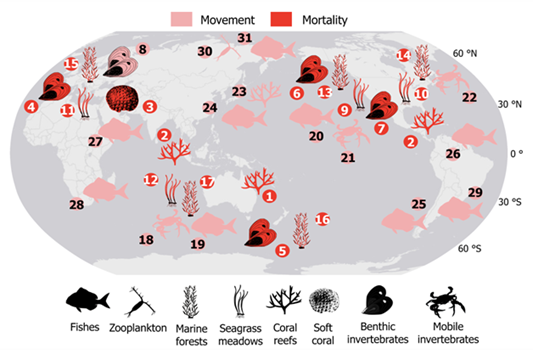
Description: Marine heatwaves (MHWs) are acute thermal anomalies and among the most severe manifestations of anthropogenic climate change. MHWs are driving widespread and often abrupt shifts in community structure, productivity, and ecosystem function. This project will examine how both intrinsic properties of heatwaves (e.g. duration, maximum and cumulative intensity) and extrinsic context (e.g. species’ range position, proximity to thermal tolerance limits) influence the magnitude and variability of biological impacts across taxa and habitats. The project will build on meta-analyses of a global database of marine heatwave impacts, spanning six decades, all major biogeographical realms, and diverse taxonomic groups. The project may also integrate field surveys (SCUBA) or aquarium experiments to complement the meta-analyses. A background in marine science and ecology is essential.
Level: Honours, Masters and PhD
Molecular and physiological basis for resilience in temperate seaweed forests
Supervisory team:
Prof Thomas Wernberg – thomas.wernberg@uwa.edu.au
Dr Antoine Minne – antoine.minne@uwa.edu.au
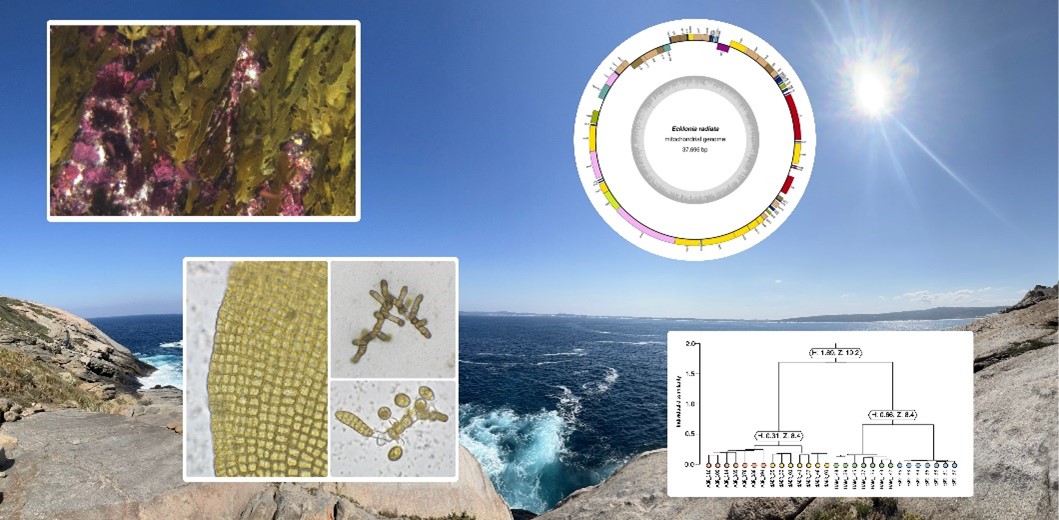
Description: This project will uncover the physiological and molecular mechanisms that underpin how temperate seaweeds respond and adapt to ocean warming and other stressors. The project will identify adapted and maladapted genotypes and populations, to understand how these differences translate into long-term population resilience. The project will also study plastic responses to temperature, light and nutrient regimes to assess how early-life exposure influences later stress tolerance. Working with field collected specimens as well as laboratory reared cultures of early life stages, the project will combine controlled laboratory and aquarium experiments with molecular analyses spanning genomic to transcriptomic tools to link physiological performance with underlying molecular mechanisms. Quantitative skills and motivation for experimental and molecular work are required. Experience with marine ecology is advantageous but not essential.
Level: Honours, Masters and PhD.
Biodiversity associated with kelp forests and vulnerability to disturbances
Supervisory team:
Prof Thomas Wernberg – thomas.wernberg@uwa.edu.au
Dr. Shinae Montie – shinae.montie@uwa.edu.au
Dr Karen Filbee-Dexter – karen.dexter@uwa.edu.au

Description: Biodiversity loss and ecological change are accelerating in temperate marine ecosystems as climate change and human pressures reshape coastal habitats. Kelp forests, which form the structural foundation of these ecosystems, support diverse and complex assemblages of invertebrates, fishes, and algae. This project will investigate how biodiversity and community composition shift as kelp forests transition to replacement states, and identify the ecological processes that underpin resilience or collapse. The research will combine analyses of existing datasets with new biodiversity data collected through complementary approaches, including field surveys, underwater imagery, and molecular methods such as eDNA. The project may involve collaboration with international partners working on kelp forest systems across the North Atlantic. A background in marine science or ecology is essential.
Level: Honours, Masters and PhD.
Impacts of multiple stressors on kelp forests and temperate species
Supervisory team:
Prof Thomas Wernberg – thomas.wernberg@uwa.edu.au
Dr Karen Filbee-Dexter – karen.dexter@uwa.edu.au

Description: While climate change has been a major driving force underpinning the decline of temperate species in many places, humans also affect the environment in many other ways. Because of the potential interactions between multiple stressors, it is important to understand their ecological and evolutionary consequences. This project will investigate the impacts of combined stressors on temperate species and examine the trade-offs involved in adapting to different pressures. Controlled experiments will be used to test how temperate species respond to variation in light (coastal darkening), nutrients and temperature (marine heatwaves), and whether adaptation to one factor influences capacity to respond to other factors. The project can be field- (SCUBA) or laboratory/aquarium-based, and may involve different types of marine organisms and communities. A background in marine science and ecology is essential.
Level: Honours, Masters and PhD.
Export of blue carbon from kelp forests to deep marine sinks
Supervisory team:
Dr Karen Filbee-Dexter, karen.dexter@uwa.edu.au
Dr. Mirjam van Der Mheen, mirjam.vandermheen@uwa.edu.au
Dr. Albert Pessarrodona, albert.pessarrodona@uwa.edu.au
Description: The ocean plays a vital role in the global carbon cycle and acts as a key buffer against climate change. Although the coastal ocean covers only a small percentage of the global ocean surface, it is one of the most productive regions and plays an important role in the ocean carbon cycle. It contributes to carbon sequestration through the uptake of atmospheric CO2 and export of both inorganic and organic carbon into the deep sea. This project will quantify different components of coastal ocean carbon export and can be approached from different angles: 1) quantifying physical export mechanisms; 2) quantifying atmospheric CO2 uptake and export of dissolved inorganic carbon; 3) quantifying export of organic carbon from different sources.
The project can incorporate numerical modelling, field, and laboratory components as desired.
Level: Masters and PhD
Spatial mapping and modelling of marine forest functions in Western Australia
Supervisory team:
Dr Karen Filbee-Dexter, karen.dexter@uwa.edu.au
Prof Thomas Wernberg, thomas.wernberg@uwa.edu.au
Lianna Gendall, lianna.gendall@uwa.edu.au
Description: We’re looking for students interested in using spatial mapping and/or modelling to explore how climate change is reshaping functions of Western Australia’s iconic seaweed and kelp ecosystems. These habitats play a vital role in coastal biodiversity, carbon and nutrient cycling, and ecosystem resilience, yet are increasingly threatened by warming oceans and marine heatwaves. Developing accurate spatial maps and predictive models of their distributions and critical functions is essential for understanding future reef services, identifying climate refuges, potential areas for restoration and building baselines for long-term monitoring and management. Projects may focus on habitat mapping, environmental modelling, or predicting future shifts in seaweed distributions and/or functions under conservation scenarios. Students with skills or interest in R, QGIS, or ArcGIS are especially encouraged to get involved.
Level: Masters and PhD
Future proof conservation approaches for marine ecosystems
Supervisory team:
Dr Karen Filbee-Dexter – karen.dexter@uwa.edu.au
Prof Anna Smajdor – anna.smajdor@ifikk.uio.no
Description. Human-driven impacts on our oceans are intensifying and there is urgent need for novel solutions to combat habitat loss and promote resilience in marine ecosystems. Warming temperatures, intensifying extreme events, and ecological tipping points are pushing natural systems into entirely new states, where traditional goals of “restoration” to historical baselines are no longer feasible. As species and ecosystems cross thresholds of tolerance, conservation must evolve to address not just the protection of what remains, but the creation of ecological resilience in an unfamiliar future. This project explores how synthetic biology, and specifically synthetic DNA (synDNA), could transform conservation in this new era. Synthetic biology enables the redesign of genetic pathways, conferring resilience to stressors or even constructing novel organisms capable of performing critical ecological roles once lost to extinction. This research will critically investigate the scientific, ethical, and governance dimensions of synDNA applications for ecosystem recovery—asking whether we can, and should, use engineered life to restore function in collapsing marine systems. This is a interdisciplinary project, and some experience in biology and philosophy is preferred.
Level: Masters and PhD.

 Wernberg & Filbee-Dexter Labs