
Temperate marine ecosystems under tropicalisation: an insight of species redistributions and ecological function changes along the Western Australia coastline (PhD)
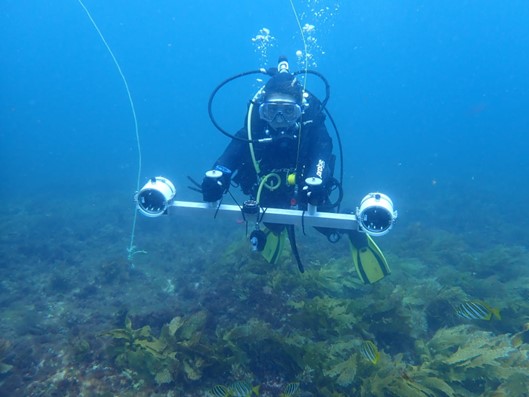
The redistribution of species globally has emerged as one of the most significant biological responses to anthropogenic climate change. Oceans are warming at an unprecedented rate, pervasively altering ecosystem dynamics and functions. The Western Australian coastline is a sentinel for such impacts, with significant changes in ecosystems such as those recorded after an extreme 2011 marine heatwave. Among the most evident and ecologically relevant is the range contraction of the main habitat-forming seaweed, the golden kelp, Ecklonia radiata. Cool-water species receding and warm-water species expanding poleward lead to tropicalised ecosystems at the warmer edges of temperate reefs. The tropicalisation of temperate kelp forests ultimately generates novel biological assemblages being dominated by warm affinity seaweeds, algal turfs or corals. While these different scenarios have been previously described in the literature, tropicalised ecosystem structure and functions remain poorly understood. My PhD will investigate how the tropicalisation of Western Australia temperate reefs has affected community-level structure and ecosystem functions.
Supervisors: Albert Pessarrodona, Thomas Wernberg, George Wood,
Qualifications
- 2020: MSc in Biodiversity, Ecology and Evolution, specializing in Biodiversity of Tropical Aquatic, Coastal, and Island Ecosystems., University of Reunion Island (France).
- Thesis: Halophila ovalis microbiome: diversity and functional role of seagrass associated bacteria
- Thesis: Characterization of fish populations based on the health status of the habitat: the case of the Trou d’Eau reef flat, Reunion Island.
- 2018: BSc in Life Sciences, specializing in Organismal Biology, Ecology, Ethology, and Evolution (BO3E)., University of Rennes 1 (France).
Peer reviewed publications
- Attlan O, Wernberg T, Wood G, Pessarrodona A (2025) Diverging carbonate budgets following tropicalisation of temperate reefs. Proccedings B, accepted 13/10/25.
- Azofeifa-Solano JC, Attlan O, Pygas D and Brooker RM. (2022) Evidence of corallivory in the urchin clingfish Diademichthys lineatus. Mar. Biodivers. 52, 53. https://doi.org/10.1007/s12526-022-01296-y
- Tarquinio F, Attlan O, Vanderklift MA, Berry O and Bissett A (2021) Distinct Endophytic Bacterial Communities Inhabiting Seagrass Seeds. Front. Microbiol. 12:703014. doi: 10.3389/fmicb.2021.703014
- Pessarrodona A, Attlan O, Wernberg T (2025) Significant carbonate production on a temperate reef system in Southwestern Australia, Marine Environmental Research, in press.
Achievements and awards
- 2025: Grant winner, The Holsworth Wildlife Research Endowment.
- 2024: Grant winner, The Holsworth Wildlife Research Endowment.
- 2024: Grant winner, Robson & Robertson award.
- 2023: Grant winner, John Glover (Royal Society of Western Australia)
- 2023: Grant winner, Australian Wildlife Society
- 2023: Grant winner, Robson & Robertson award.
- 2023: Grant winner, The Holsworth Wildlife Research Endowment.
- 2022: Australian Government Research Training Program (RTP) Fees Offset Scholarship and University Postgraduate Award (UPA) Scholarship (UWA).
Links
 Wernberg & Filbee-Dexter Labs